
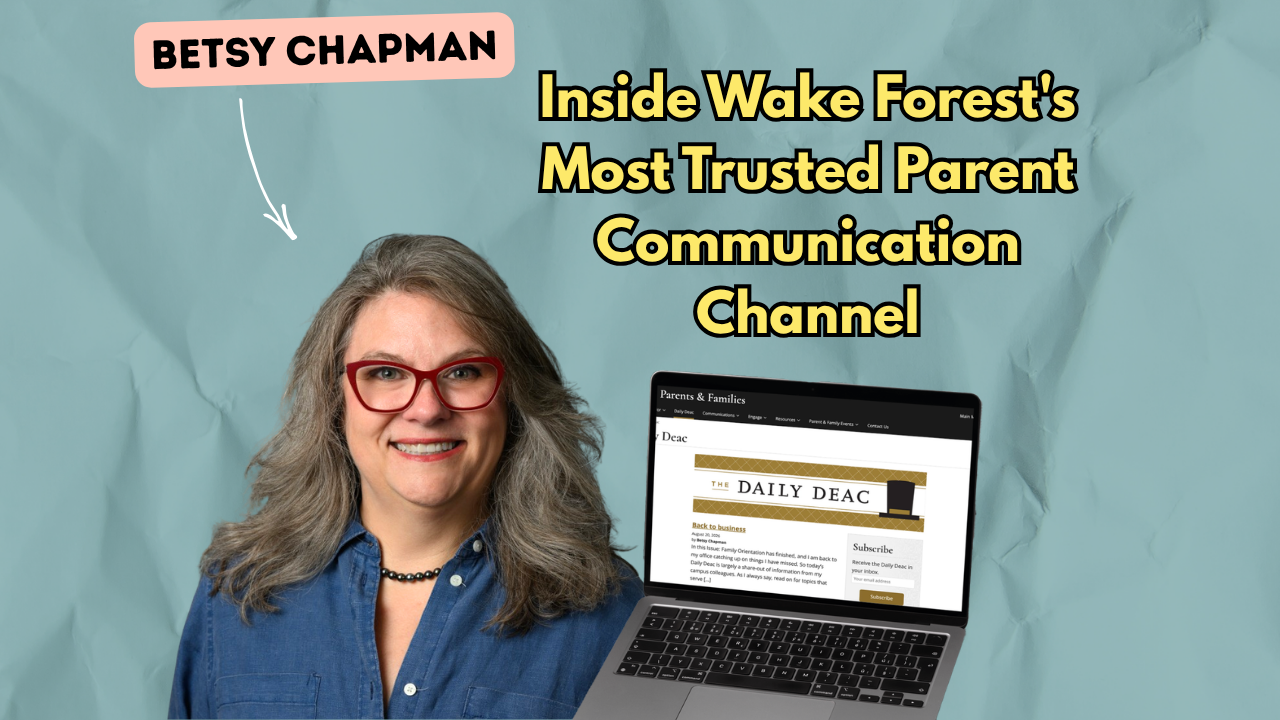
#115 - Inside the Daily Deac Blog: How Wake Forest Built a Trusted Parent Communication Channel
My guest today is Betsy Chapman, Senior Executive Director of Family Communications and Engagement at Wake Forest. Betsy is the voice behind the Daily Deac, a blog for parents and families that's been running nearly every weekday for over a decade and has grown to roughly 8,200 subscribers.
Betsy walks through how the Daily Deac started as an alumni blog called Quad View, how it evolved into the go-to source of information and comfort for Wake Forest parents, and the philosophy behind "Stop, Drop, and Roll" — her framework for helping families support their students without taking over for them. She also shares findings from her own dissertation research linking how deeply families read parent communications to student satisfaction, self-advocacy, and giving behavior.
Key Takeaways:
A named, first-person author builds more trust with readers than an institutional or departmental voice — Betsy's dissertation research on corporate and institutional blogs backed this up directly.
The Daily Deac isn't written from scratch every day — a mix of predictable, cyclical campus content (move-in, midterms, finals) and campus partner requests keeps the workload manageable, often just 15 minutes to an hour a day.
Schools don't need a new hire to start something like this — existing staff in communications, alumni, or student life offices can contribute, or the role can rotate across departments.
"Stop, Drop, and Roll" reframes how families should respond when a student calls with a problem: stop and assess whether the student can handle it, drop your urge to fix it, and roll with whatever solution the student lands on.
Betsy's dissertation found a correlation between how frequently and deeply parents read university communications and three outcomes: higher satisfaction, less direct intervention with university offices, and increased giving to the annual fund.
Some of the most-loved posts weren't polished or strategic — a "five senses" post written during a bout of writer's block, just describing what Betsy observed walking across campus, became one of the most emotionally resonant posts she's written.
Feedback and even pushback from readers (including families who felt a post was condescending) has directly shaped how Betsy frames advice — she treats critical feedback as information, not an attack.
Connect With Betsy:
Email: parents@wfu.edu
Find the blog: search "Daily Deac Wake Forest"
Connect With John:
LinkedIn: https://www.linkedin.com/in/johnazoni
Website: https://unveild.tv
Newsletter: https://unveild.tv/newsletter
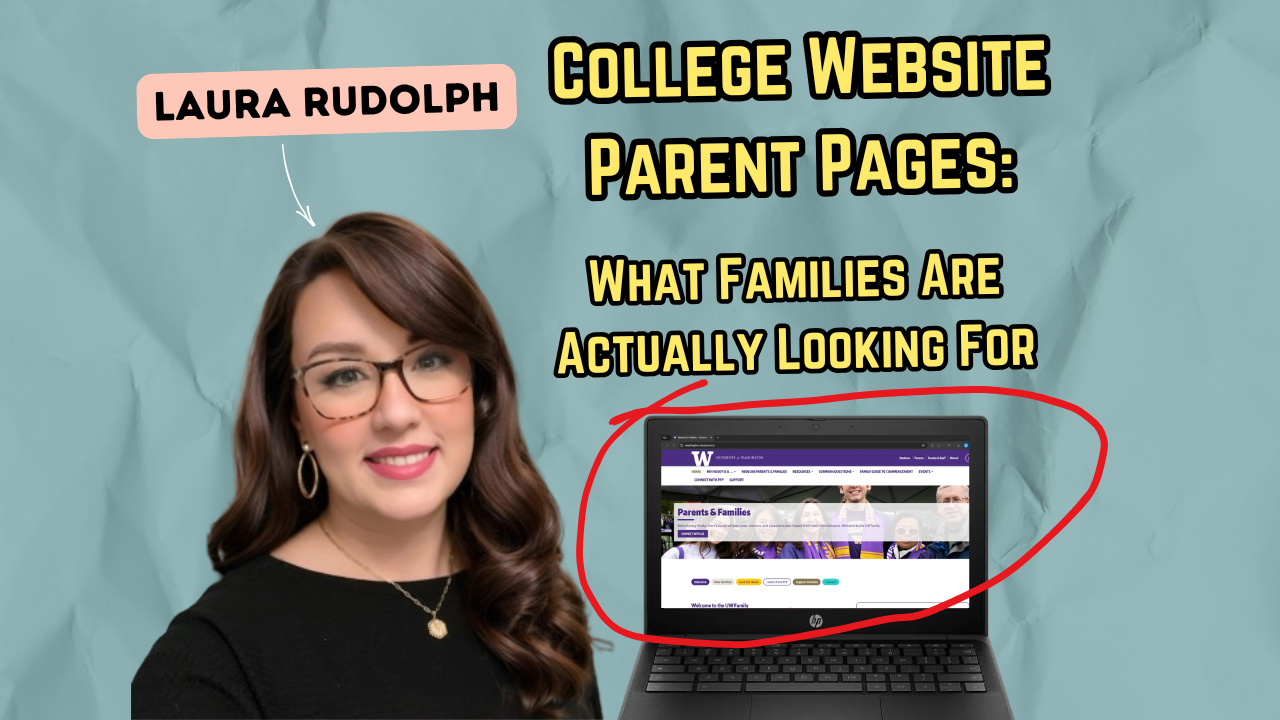
#110 - What College Parents Actually Need From Your Website, and What Higher Ed Is Getting Wrong
Most college parent pages were built by someone who ran out of time and dumped every link they didn't know what to do with into a pile. Laura Rudolph has spent a decade trying to fix that.
Laura is the founder of Square One Consulting, where she helps colleges communicate more clearly and — as she puts it — speak more human. She started her career as a journalist with a crime beat, fell into enrollment marketing, and eventually realized that the audience nobody was talking to — parents — was the one she was most drawn to write for. Turns out, skeptical Gen X parents who want honesty and hate marketing fluff are basically the ideal audience for a former investigative journalist.
In this episode, Laura breaks down why most parent pages fail, what good actually looks like, and the three pieces of content she'd build first if she were starting from scratch. We also walk through real examples from University of Washington, UT Austin, Hamilton, and Wake Forest — and Laura shares a free AI-powered tool she just launched that lets you drop in a URL or paste a parent email and get an honest assessment of whether it's actually working.
In this episode:
Why most parent pages are "informationally present but emotionally absent" — and what that costs you
The filing cabinet problem: why organizing your site around your org chart is failing families who don't know what a bursar does
The three content pieces Laura would build first: a "Start Here" guide, a "What Families Worry About" hub, and a "How to Support Without Taking Over" section
Why telling parents why you want their contact info resulted in a dramatic increase in opt-ins at Laura's former institution
What University of Washington, UT Austin, Hamilton, and Wake Forest are doing right — and what makes each of them a model worth studying
The parent-to-parent trust play most schools are completely ignoring
Why there's a middle ground between helicopter parenting and institutional silence — and how your content can actually help create it
The free tool: Laura's AI-powered Parent & Family Communication Analyst is live at squareoneky.com. Drop in a URL or paste an email and get a scored, tiered review of how well your communication is actually working for a parent audience. It's free.
Good parent page examples mentioned:
University of Washington: https://www.washington.edu/parents/
University of Texas at Austin: https://parents.utexas.edu/
Hamilton College: https://www.hamilton.edu/parents
Wake Forest University: https://parents.wfu.edu/
Providence College (honorable mention for parent blog): https://parents.providence.edu/
Connect with Laura:
Website: squareoneky.com
LinkedIn: linkedin.com/in/laurakrudolph
Connect with John:
LinkedIn: linkedin.com/in/johnazoni
Website: unveild.tv
Newsletter: unveild.tv/newsletter