

#113 - The Most Important (and Hardest) Part of Storytelling: Finding the Stories to Begin With
In this solo episode, John tackles a problem he thinks is way more foundational than filming or editing: casting. Before you can tell a great story, you need someone willing to raise their hand and tell it — and John argues that's the part most higher ed teams are actually failing at.
Drawing on conversations with clients and his own experience running Unveild's story-sourcing process, John breaks down why the standard approach — a mass email asking people to "tell your story" — usually falls flat, and walks through what he's currently experimenting with instead: smaller asks, better timing, and specific prompts that help people recognize they actually have something to say.
Key Takeaways:
The hardest part of great storytelling usually isn't the production — it's finding people with real stories who are willing to participate in the first place.
Mass emails asking people to "tell your story" tend to underperform because the ask is too vague, too impersonal, and easy to ignore.
Many students and alumni self-disqualify because they assume their experience isn't dramatic enough — but the most compelling stories often live in small, specific, unpolished moments rather than big "hero" outcomes.
Faculty and staff referrals are valuable, but without training on what makes a story compelling, they tend to surface the same safe, polished profiles over and over.
Lowering the barrier for a first ask — a 30-second voice memo, a one-sentence response — works better than pitching someone straight into a full production, and lets you screen for communication skill and enthusiasm along the way.
Specific prompts ("tell us about a time a professor changed how you think") help people self-identify far more effectively than open-ended asks like "share your story."
Timing matters: asking during emotionally heightened moments — graduation, capstones, final critiques, the end of a clinical rotation — captures better material than following up weeks later.
Story sourcing needs to become an ongoing campus habit rather than a scramble that starts only when a campaign kicks off.
Resources Mentioned:
NPR's The Moth – referenced for its low-friction voicemail-style story submission format
Armchair Expert with Dax Shepard and Monica Padman – specifically the "Armchair Anonymous" segment, cited as an example of how specific prompts generate better story submissions
Glengarry Glen Ross – referenced in passing for the "always be closing" line, which John riffs on as "always be casting"
Connect With John:
LinkedIn: https://www.linkedin.com/in/johnazoni
Email: john@unveild.tv
Website: https://unveild.tv
Newsletter: https://unveild.tv/newsletter
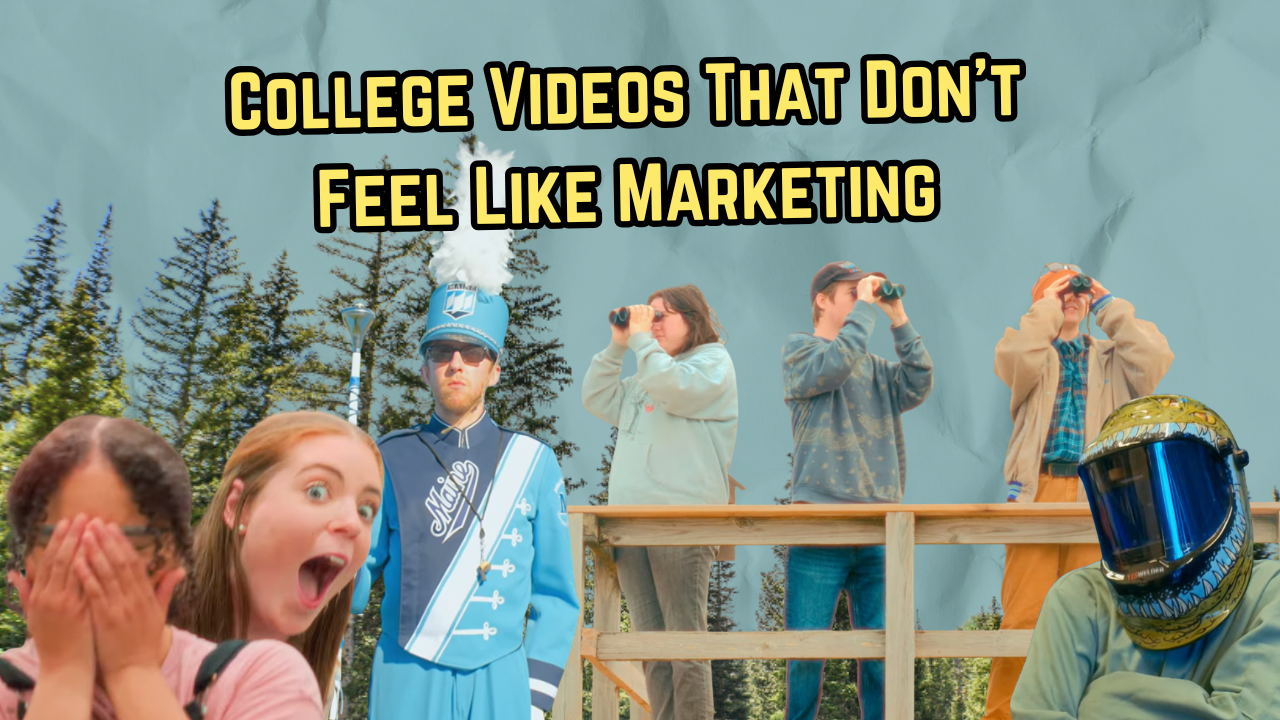
#112 - Program Videos That Don’t Feel Like Marketing - UMaine’s “Life in the Pines” Series
My guests today are Brenn Borror, who leads content strategy at the University of Maine, and Patrick Wine, founder of Story Stroll, the filmmaker behind UMaine's "Life in the Pines" series. We get into how an unscripted, vlog-style student story series came together — and why it's stuck around for three seasons.
Brenn and Patrick walk through how "Life in the Pines" started as a cold-call pitch for a generic campus tour video that they reshaped into something more specific to UMaine, why they insisted on one person, one camera, and no crew for every shoot, and how a rigged-up "snorri cam" — basically a tripod strapped under a student's arms — lets students walk and narrate their own story without feeling guided by the marketing team. We also dig into the unglamorous side of the metrics: why a nearly 40,000-subscriber YouTube channel mostly built on a viral lobster-cooking video and an old extension-office library isn't the same audience watching these student stories, and why that's actually fine.
In this episode:
Why UMaine passed on a polished, teleprompter-style tour video pitch and built something rougher and more specific instead
How the "snorri cam" walk-and-talk format gets genuine, unguided footage out of students
The one-person, one-camera rule and why it matters for getting students to relax on camera
Why calling it "seasons" and "episodes" instead of a playlist changed how people watched it
How a pre-interview process surfaces the small, specific details (like a chocolate bar traded for a bicycle) that make a story worth following
Why low YouTube view counts don't mean the series isn't working, and what they're actually using it for in the funnel
How casting evolved from proactive outreach to an open call, and why they now ask for a 60-second video submission
Why retention, not just recruitment, is a real benefit of this kind of content
Resources mentioned:
Life in the Pines (full series hub): https://umaine.edu/pines/
Life in the Pines, full episode: https://www.youtube.com/watch?v=Ue-xo4MsoTs
Life in the Pines, teaser trailer: https://www.youtube.com/watch?v=m1hKbuFXtw8
Life in the Pines, Season 2 full episode: https://www.youtube.com/watch?v=l2axURGS18I
The University of Maine's YouTube channel: https://www.youtube.com/user/TheUniversityofMaine
Story Stroll Studios (Patrick's production company): storystrollstudios.com
Connect with Brenn:
LinkedIn: https://www.linkedin.com/in/brennborror/
Connect with Patrick:
Story Stroll Studios: storystrollstudios.com
Linkedin: https://www.linkedin.com/in/patrickmwine/
Connect with John:
LinkedIn: https://www.linkedin.com/in/johnazoni
Website: https://unveild.tv
Newsletter: https://unveild.tv/newsletter