
How to Write Clear, Action-Driving Emails in Higher Ed Marketing
Email remains one of the most important communication channels in higher ed — especially for prospects who have just requested information. Yet many institutions send emails that are dense, unclear, or ineffective at moving students to the next step.
If you want your emails to get opened, read, and acted on, here’s a simple framework based on proven techniques that work in B2B and apply perfectly to higher ed.
Let’s start with an example from our friend Josh Cantrell at Signal Brandworks. He launched a new product recently and sent what we thought was a really well-structured email.
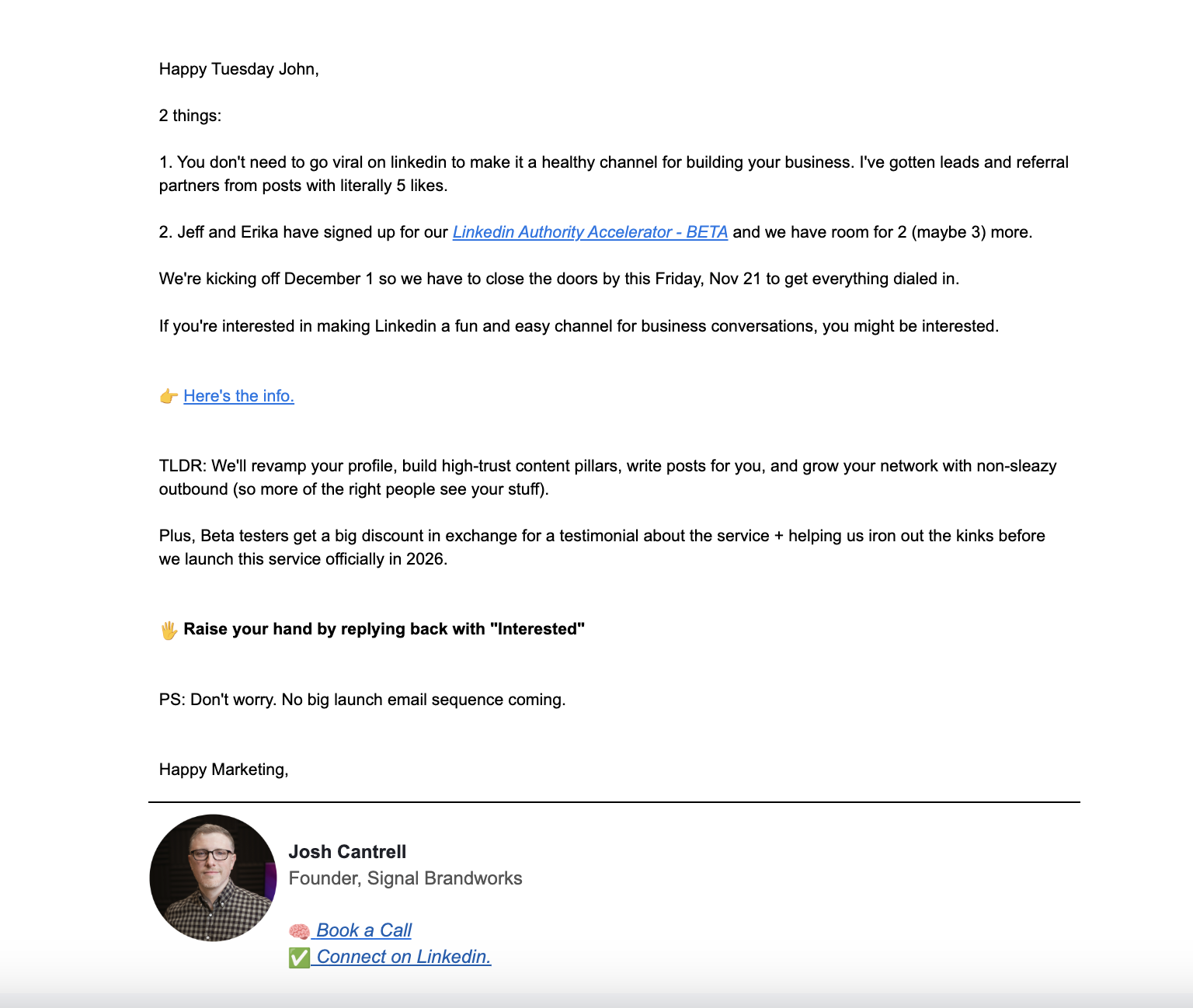
6 Things to Learn From This Email
1. Lead With What You Want the Reader to Know
Strong emails set expectations immediately.
If your email includes two key points, say that at the top:
“Here are the 2 things you need to know.”
This reduces cognitive load and helps the reader process your message quickly — a critical advantage when speaking to busy or overwhelmed prospective students.
2. Put the Most Important Information at the Top
Higher ed emails often bury the main point several paragraphs in.
Don’t do that.
Place your core message (the next step, the link, the resource, the call to action) near the very beginning so the reader can’t miss it.
3. Include Clear, Repeated Calls to Action
If you want the reader to take an action — schedule a visit, download a brochure, start an app, reply to a counselor — link to it more than once.
Two strategically placed links ensure the CTA is visible for both scanners and deep readers.
Make the CTA unmistakable:
“Here’s the link to schedule your visit.”
4. Add a TL;DR for Skimmers
Most people skim email.
A short TL;DR (“too long; didn’t read”) lets prospects quickly understand the value of your message and decide whether to engage further.
This is an easy way to increase engagement with mobile readers in particular.
5. Make the Next Step Simple and Explicit
Prospective students shouldn’t have to guess what you want them to do.
Great emails use phrases like:
“Your next step is…”
“Here’s what to do if you’re interested…”
“Click here to…”
Clarity increases conversion.
6. Remove Friction and Unspoken Fears
One of the most underrated tactics in high-performing emails is addressing the reader’s hidden anxieties.
For example:
“If you’re not interested after this, no worries — I won’t keep emailing you.”
In higher ed, this could be:
“This isn’t an application — it’s just a quick form to help us recommend programs.”
“You won’t get added to a large list — this goes directly to your counselor.”
Removing fear increases action.
Why This Matters for Higher Ed
Most RFI (Request for Information) email sequences are failing students. Recent secret-shopping across multiple institutions reveals common problems:
Dense blocks of text
Generic “we’re the best” messaging
Cliché subject lines like “You belong here”
No clarity on the next step
Missed opportunities to answer the questions prospects are actually asking
Overall poor design and user experience
These emails are some of the highest-stakes communications in the entire enrollment journey. They influence whether a student moves forward — or disappears.
They deserve more strategic thought — and more skill — than they typically receive.
Want more insights on creating emotionally resonant content for higher ed?
Join my free weekly newsletter.👇